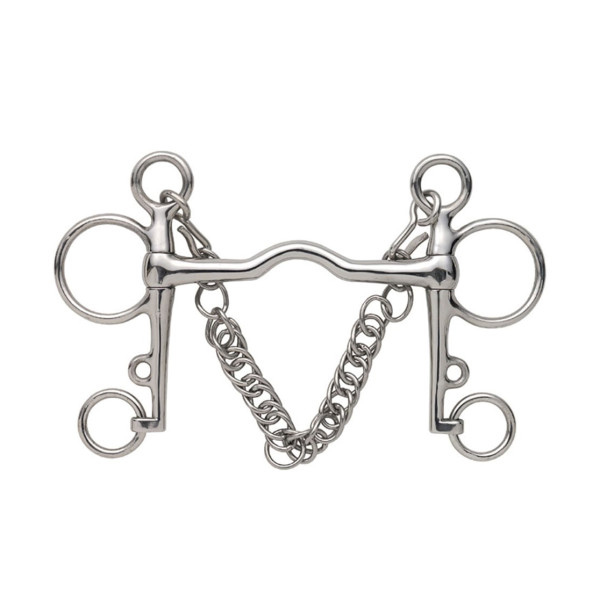


The pelham bit is a more simplistic form of the double bridle, combining the effects of the bridoon and weymouth into one single bit.
In appearance the pelham consists of one single mouthpiece, with large rings on either side to which the "snaffle reins" are attached. Above these rings are cheeks to allow the cheekpieces to be attached, and extending downwards the shanks finish with a loose ring where the "curb reins" are fastened. Fitted behind the bit is a curb chain, which sits on the horse's chin groove and held stable by a thin leather lip-strap. An alternative to this bit is the rugby pelham, it works in exactly the same manner but gives a more realistic appearance to the double bridle as is designed with a loose bit-ring.
This bit can be milder or stronger by its designed. Cheek and shank length determines how much leverage the bit has, the longer the shanks the more leverage they provide and therefore the stronger the action. The material of the mouthpiece can also affect the strength of the action in the horses's mouth; bits made from metal materials such as stainless steel and copper will be stronger than those constructed from rubber, vulcanite, or plastic (happy mouth). Jointed mouthpieces and tongue grooves will also provide more activity on the tongue than ones which are straight or mullen mouthed.
Additional to the actual bit, the different curb chains available can also alter the strength of the bit. The two metal curb chains are the single link, which is the most severe and rarely used today, and the double link which is a popular choice and commonly used. If the equine is too sensitive for a metal chain leather, elastic, or gel curb chains are also available offering a milder effect against the horse's jaw. Also available is a rubber guard which can be fitted over a metal curb chain for short term use.
In conjunction with a curb chain, a lip-strap should be fitted. It is attached to either side of the shanks and is threaded through the fly-link on the curb chain. It serves several purposes: it helps keep the curb chain in place preventing it from rising, it stabilises the shanks to keep them in alignment and also prevents the horse from getting hold of the shanks with their teeth. When the bridle is removed it prevents the curb chain falling off the bridle and getting lost.
On the horse the mouthpiece works on the corner of the lips, bars and tongue. The curb chain acts directly on the chin groove, whilst the upper cheeks and shanks activate the curb chain and prompt the headpiece to place pressure on the poll.
When fitting a pelham it is positioned slightly lower than a snaffle bit, sitting comfortably at the corners of the horse's mouth. When the mouthpiece is pulled out to one side there should be ¼ of an inch gap between the lip and bit-ring. The curb chain should lie flat against the chin groove, be free from twists, and secured at the correct tension as it is this which ultimately controls the strength of the bit. When a contact is placed on the bottom reins, the curb should act against the chin groove when the shanks are rotated at an angle of 45°. If the curb chain is fitted too loosely the bit will be allowed to rotate too far in the horse's mouth, thus creating large amounts of pressure on the tongue and bars. This will be seen by the shanks rotating more than 45°. When fitted too tightly the action will be very severe, putting vast amounts of pressure on the poll and lower jaw.
Pelhams can be ridden with either one or two sets of reins, depending on the reason why it is being used. If only one set of reins are being used then the snaffle and curb rings must be connected to each other by leather adapters called "roundings", the reins are then attached to the centre of these roundings on each side. When two sets of reins are fitted one set is attached to the mouthpiece bit-rings and the second set is fastened onto the ring at the bottom of the shank. The top set of reins are usually thicker and a different style to the bottom set, which tend to be plain. If a running martingale is used with a pelham in double reins, it is always fitted onto the snaffle rein; if only one rein is used it will be attached directly to that one.
Double reins allow the rider to differentiate between the snaffle and the curb. Similar to the double bridle, the snaffle rein raises and flexes the horse's head and should be predominantly ridden off. Activating the curb reins places pressure on the poll and chin groove to lower and encourage the head towards the vertical, plus it helps to relax the lower jaw. When both these actions are used accurately this bit can encourage a soft mouth and the correct head carriage. This method of using the pelham can be useful when re-schooling stronger equines, or as a simpler way of introducing the curb to a horse before moving forward to the double bits. It can also be used for equines with very small mouths who can't fit double bits. Whilst this is a popular choice of bit and is frequently used in the showing ring, it will never offer the same refinement or be as effective to the aids as the double bridle. It is not permitted to be used in dressage at any level.
Used with roundings, one set of reins prevent the refinement of the rider's aids as both the snaffle and curb actions are always activated together. Typically this is implemented when the pelham is being used for additional control on horse's who are strong and pull against the bit whilst jumping, hacking, or riding cross-country. Furthermore, it can be useful on strong ponies where the child may not be able to cope with the double reins.
The Kimblewick:
The kimblewick is similar to the pelham, offering a curb action, but can only be ridden using one set of reins.
It consists of either a straight or jointed mouthpiece, which can be made from a variety of materials. A single set of reins are attached directly onto the "D" shaped bit-rings, a uxeter kimblewick has additional slots which the reins can be fitted to increase the amount of leverage on the curb chain and pressure on the poll. It is always fitted with a curb chain, which sits on the horse's chin groove, but unlike the pelham it does not have a lip-strap.
On the horse this bit works on the bars, tongue, lips, corners, poll and chin groove. It is typically used for equines who are strong or pull and the rider requires extra braking power. It is fitted in the same way as a normal snaffle, the curb chain should sit into the chin groove, and not be fasten too tightly.
It is not permitted to be used in dressage, and is typically seen on strong ponies.