Saddles are designed to offer stability to the rider whilst on the horse. Customarily the external part of the saddle is made from leather or synthetic materials, usually black or brown in colour. The framework is known as the 'tree', it can be made from wood, a flexible synthetic material, or carbon fibre and is what determines the different widths, lengths and shapes of saddles available. Saddles without this rigid structure are referred to as 'treeless'.
General purpose saddles are a popular choice as they allow the rider to perform flat work, jumping and hacking without the need for a change of saddle. For those partaking in specific disciplines, such as dressage or jumping, there are saddles designed to cater for the requirements of that sport.
A qualified saddle fitter must accurately fit the saddle to the horse, whilst also considering the rider's body shape if the equine is individually owned. For instances where the equine has a variety of riders, such as in a riding school, the saddle must be solely fitted to the horse. An ill fitting saddle will not only encourage the horse to work incorrectly, it can cause them tremendous discomfort and pain. Prolonged use of a saddle which doesn't fit can create sores, white hairs and muscle wastage around the back and withers area. Following the initial fit of the saddle, it must be re-checked every 6 months to accommodate for any changes in body shape throughout the year.
When fitting a saddle it is vital to match the correct type of tree with the horse's back. Saddle trees range considerably between flat trees, suited to equines with limited spinal curve, and arched trees tailored to horses with a sway back. An adjustable tree allows easy alterations to be made, however it is important to state that the amount of adjustment in these saddles is limited. Modifications are isolated to the wither area, and can not change the panels which clear the equine's spine. This means that adjustable saddles designed to fit a wide-backed cob will not be suitable for a high withered narrow thoroughbred type and vice versa.
Second hand saddles are a good way of purchasing an expensive saddle at a lower cost. However, the saddle MUST fit the horse and rider, regardless of the condition or price. A second hand saddle should always be fitted using the same method as a new one; a reputable saddle fitter must check the soundness of the saddle and fit it to the horse.
Accessories on the saddle should be checked regularly for safety and the appropriate fit. Stirrup leathers should be the correct length and thickness for the rider, plus be the same colour as the saddle. Irons should be made from suitable strong material and be the correct size for the rider's foot (¼ of inch gap between the foot and stirrup on both sides). Treads must be in good condition.
When fastened at full tension, the girth should sit half way up the girth straps on both sides. This helps the saddle create equal pressure on the horse's back, plus allows for small deviations in the equine's weight. A girth which is too small will be difficult to fasten and cause pressure on the muscles around the horse's girth area. If it is too long, it cannot be fastened at the correct pressure creating an un-stable saddle.
If the saddle is fitted with 3 girth straps for security the girth should be fastened on either straps 1 and 2, or 1 and 3. Straps 2 and 3 should not be used together as they are connected to the same piece of webbing, therefore if either strap failed the girth would completely undo. Many saddles now have an additional strap fitted at the front, this is known as the 'point strap' and is attached to the tree point. This strap is useful for equines with a forward girth line, or if the saddle has a tendency to slip forward. If this strap is not needed straps 2 and 3 or 2 and 4 should be used. Buckle guards should be fitted on both sides to protect the saddle flaps from the girth buckles.
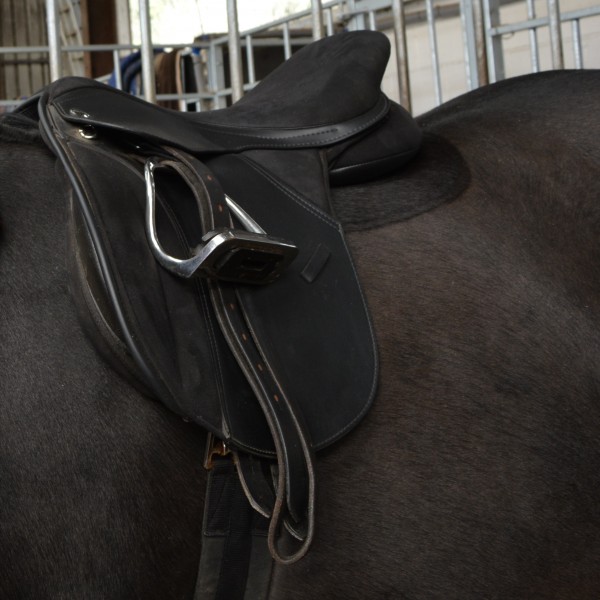
When checking the fit of a saddle, it should be assessed without a numnah and the girth tightened at the correct tension.
The angle and width of the tree must correspond to the shape of the horse’s back.
Length and width of the saddle should be correct for the individual equine. If the saddle is too narrow or small it will pinch the withers, shoulders or back, plus restrict movement, and not distribute the weight evenly around the horse’s back. A saddle that is too wide or big will sit too low on the horse’s back or spine and move around excessively causing rubs, sores, discomfort or pain.
Important: To truly see if a saddle fits the horse, it must be viewed with a rider on, assessed in all 3 paces and if applicable over fences.
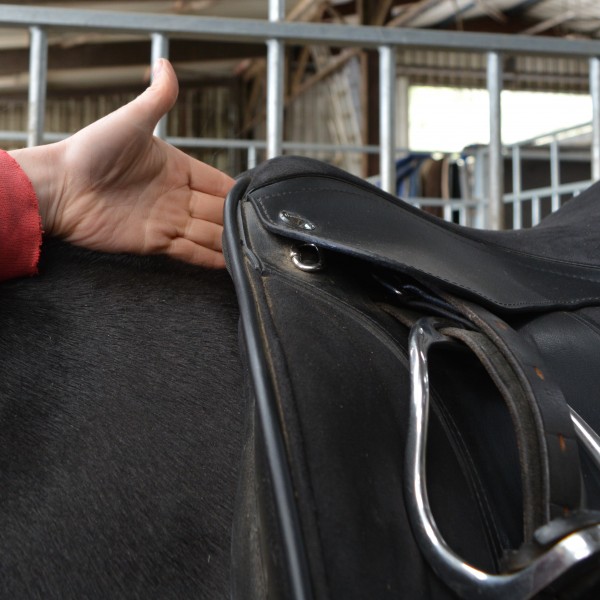
When checking the space between the withers and pommel area there must be adequate clearance above and on either side of the withers. Under no circumstances should the saddle ever be in contact with the thoracic vertebrae.
The amount of space can vary depending on the saddle’s design and the horse’s conformation; it must be checked both when the rider is dismounted and mounted. A general rule when assessing this area is:
If the saddle is sat on or close to the withers it is too wide for the horse; if there is more than 3-4 fingers clearance above the withers and less than 2 fingers around the withers the saddle is too narrow.

To allow freedom of movement for the scapula and front limbs there should be even pressure between the shoulder and side of the saddle. The stirrup bars must be identically positioned and not feel tighter than other parts of the saddle.
Assess this area by placing one flat hand between the front of the tree and the shoulder then slide it down from top to bottom. Even pressure should be felt all the way down.
Excess tightness can indicate the saddle is too narrow, or the shape or angle of the tree is not compatible with the horse’s withers and shoulder blades.
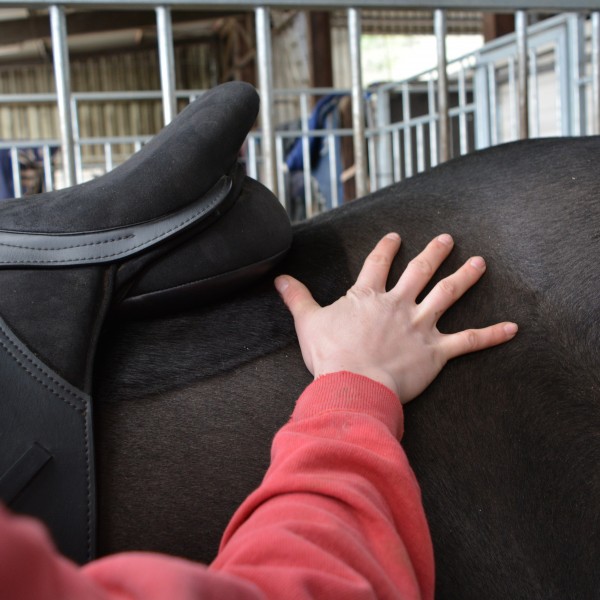
The panels on the back of the saddle should never extend beyond the 18th (last) rib, or sit on the horse’s loins as they are the weakest part of the horse’s back.
A simple guide to check the correct length is to place one hands span between the top of the flanks and the back of the saddle’s panel. More than one hands span indicates the saddle is too short, likewise less than one hands span means it is too long.
If the saddle is too long it will place pressure on the loins area and potentially make the saddle unstable during riding sessions. This can cause the saddle to roll from side to side, lift upwards at the back, or encourage the entire saddle to slip forwards. In contrast, if the saddle length is too short it will not distribute weight evenly over the horse’s back. This can lead to pressure points and sores.
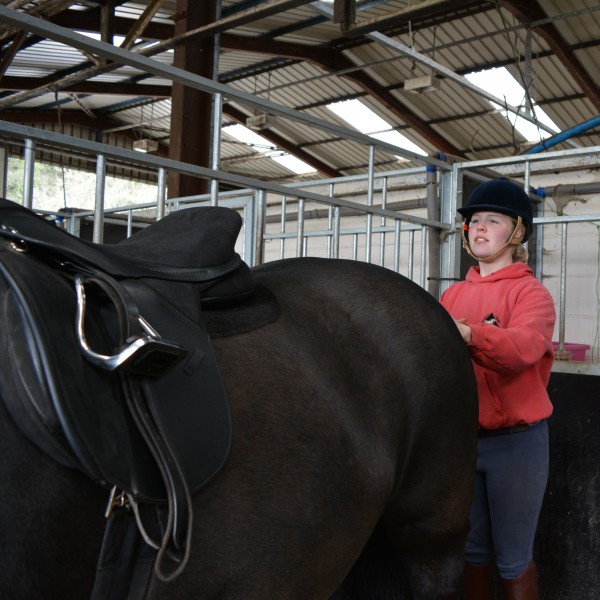
The two panels create the main bearing surface of the saddle. They should appear symmetrical, large, and evenly flocked when inspected off the horse. When the saddle is fitted the panels must be in full contact, following the outline of the horse’s back.
The gap in between the two panels is referred to as the gullet. This space should provide sufficient clearance to prevent the inside edges of the panels interfering or pressing onto the horse’s vertebrae along the entire width. The gullet should be at least 3-5 fingers in width, depending on the horse’s build.
When standing directly behind the horse, you should be able to see daylight throughout the entire length of the gullet. The panels should not touch the vertebrae on either side.
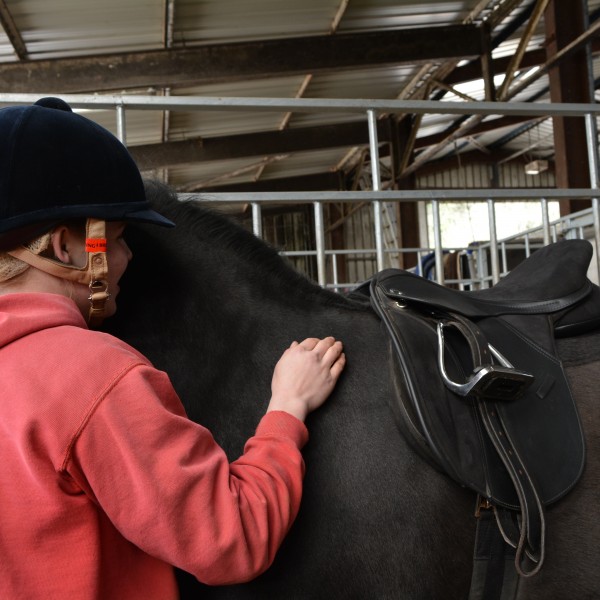
From the front of the saddle, you should also be able to see daylight all the way through the gullet.
The panels should appear symmetrical on both sides of the withers.
To test the panels run a flat hand all the way down between each panel and the horse’s back. There should be even pressure all the way along.
If the panels do not sit level at any point on the horse’s back they will cause the horse severe pressure points, discomfort and pain.
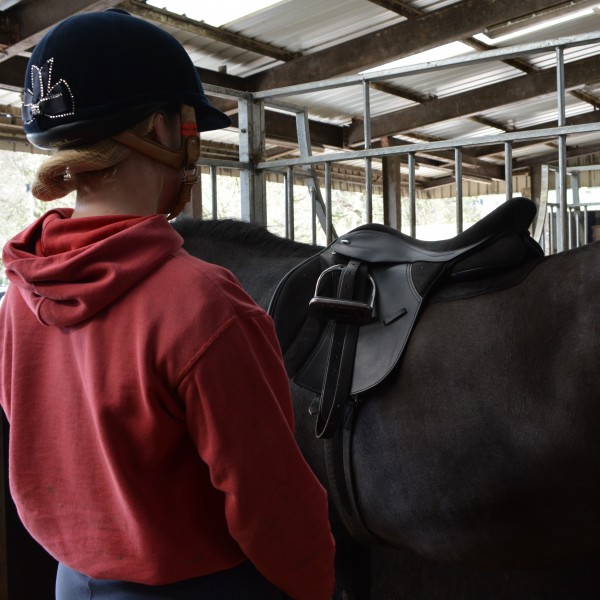
When observing from the side, the saddle must be balanced. The pommel and cantle should be level with each other. Some saddles are designed to have a higher cantle, however the pommel must never be the highest point. The deepest part of the seat should be central, allowing the rider to sit correctly in the middle. If the saddle is higher at the front the rider will feel unstable and tipped backwards. If it is higher at the back, it will tip the rider forwards.
There should be no surplus movement, such as the saddle moving up and down or from side to side. When pressing either the front or back of the saddle, the opposite point should not rise.
Saddle flaps should be the correct type and size for the horse and rider. The length of the saddle flaps depends on the rider’s thigh length. To prevent the boot catching on the bottom of the flap the top of the riding boot should sit at least 5cm above the saddle flap. Likewise, if it is too long it may interfere with the rider’s aids.